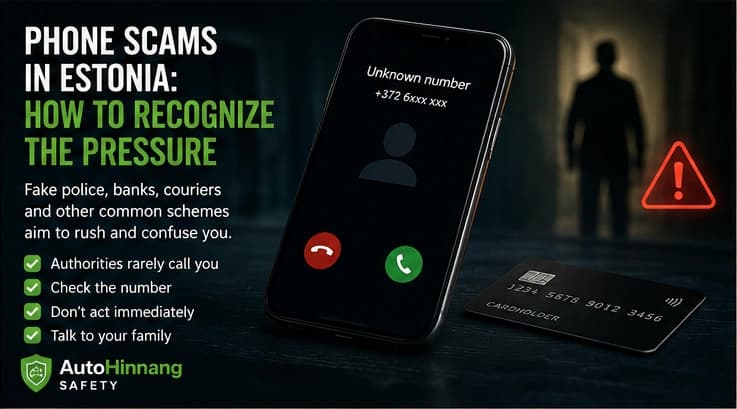
If an unknown caller creates an urgent situation and asks you to use Smart-ID, Mobile-ID, move money or hand something to a courier, end the call and independently verify the information through an official channel.
A scam call no longer has to sound suspicious
Phone scams have become significantly more professional. The caller may speak calmly, use fluent Estonian or Russian and even know the person's name or other personal details.
A scammer may impersonate a police officer, bank employee, government official or courier. Some schemes use several different callers to make the situation appear more credible.
For example, the first caller may report a suspicious transaction or fabricated problem. Another person then calls later and claims to be helping resolve the situation.
This can create the impression that several independent people are confirming the same problem, even though all of the calls may be part of the same scam.
Urgency is one of the strongest warning signs
A scammer benefits when the victim has no time to think, search for information or call someone else.
That is why scam calls often claim that money is about to disappear, a loan is being taken out in your name, your bank account must be blocked immediately or the police are investigating an urgent case.
The problem is deliberately presented as though even a few minutes of delay will cause irreversible damage.
In that situation, ending the call is usually the safest option. If the problem is genuine, you can independently contact the organisation through an official channel.
Smart-ID and Mobile-ID: never approve what you do not understand
One of the most dangerous moments occurs when a caller asks you to approve something using Smart-ID or Mobile-ID.
Entering a PIN is not merely a technical step. It may approve a login, agreement or financial transaction.
If someone else initiated the authentication or signing process during a phone call, you should understand exactly what you are approving before entering any PIN.
If the caller contacted you first and urgently asks you to identify yourself using Smart-ID or Mobile-ID, treat this as a major warning sign.
Do not trust the number displayed on your screen
A familiar or official-looking phone number is not sufficient proof of who is calling.
If someone claims to be calling from a bank, the police or a government institution, you do not need to continue the conversation simply because the displayed number looks legitimate.
The safer approach is to end the call, independently find the organisation's official contact information and call the number published on its official website.
Do not verify the caller using a number that the same person provides to you during the call or by message.
A phone scam can continue at your front door
Modern scams do not always remain online. Some schemes involve sending a courier or another participant to collect cash, a bank card or other property from the victim.
This can make the situation feel much more convincing because the scam is no longer just an anonymous phone call. A real person may physically appear at the door.
However, the presence of a courier does not make instructions given over the phone trustworthy.
If an unknown caller asks you to prepare cash, a bank card, documents or other property for someone to collect, stop the process and do not hand anything over.
Talk to someone before moving money
Scammers often try to keep the victim on the phone and prevent them from consulting someone else.
If you are told that the situation is secret, that speaking to relatives will interfere with an investigation or that you must not contact your bank, treat this as a warning sign.
Someone outside the situation is not under the same emotional pressure and may quickly notice inconsistencies.
Before making a large transfer, withdrawing cash or selling a vehicle or other valuable property, speak to at least one person you trust.
What to do during a suspicious call
You do not need to prove to the caller whether you believe them. You also do not need to argue with them or try to expose the scam yourself.
If the call involves money, your bank account, Smart-ID or Mobile-ID approval, handing over cash or an urgent financial decision, end the call.
Then verify the situation independently. Open the official website of the bank or institution, find its contact information yourself and get in touch directly.
If you have already entered PINs, shared banking information or made a transfer, act immediately: contact your bank and report the incident to the police.
Official sources
Additional information and official guidance can be found in the following sources.
Want to sell your car?
Send us your vehicle details and receive a free valuation without obligation.
Value my car