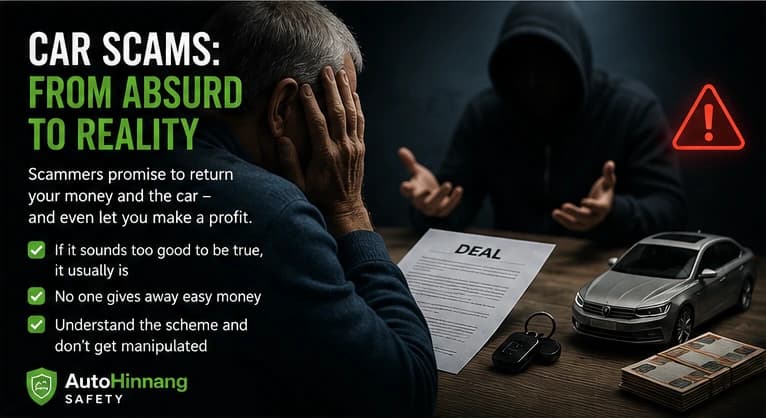
If you are told to give away a vehicle or money first and are promised the property, money and a profit later, do not take the next step without independent verification.
A case that initially sounds unbelievable
One story from the automotive world demonstrates how irrational a scam can become while still appearing convincing to the person being targeted. To preserve anonymity, the vehicle model, the owner's age and several other details in this story have been changed.
Imagine an older person who owns a reasonably valuable car, for example a 2017 Volkswagen Passat, and suddenly decides to sell it very quickly.
In a small town, people often know one another. Someone involved in buying and reselling cars learned that a relative of an acquaintance was unexpectedly trying to sell a vehicle as quickly as possible. The urgency seemed unusual, so he began asking why.
During the conversation it became clear that the vehicle owner had been speaking by phone with people who had described a supposed opportunity to make money.
The basic idea was roughly this: the owner would sell the vehicle, hand over or transfer the money received from the sale, and later supposedly receive both the money and the vehicle back. On top of that, a profit was promised.
From the outside, such a proposition sounds almost absurd. But to someone who has already spent considerable time speaking with a scammer and has been introduced to the story gradually, it can feel very different.
Why can someone believe a scheme that seems absurd to everyone else?
After hearing about such a scam, it is easy to ask: 'How could anyone believe that?' In reality, victims are rarely presented with the entire absurd scheme during a single phone call.
Trust is built gradually. The first conversations may concern completely ordinary topics. The scammer listens, asks questions, presents themselves as knowledgeable and learns which arguments are most effective with that particular person.
Another step is then added to the story. Once someone has already accepted the previous explanation, agreeing to one more small action becomes psychologically easier.
As a result, the victim may no longer perceive the situation as one enormous and obviously suspicious decision. Instead, they make a series of smaller decisions, each of which appears to follow naturally from the previous one.
The promise of profit changes how the situation feels
These schemes often exploit a powerful idea: the victim does not feel that they are simply giving something away. Instead, they are encouraged to view it as a temporary step toward a much larger reward.
If a vehicle owner believes that selling the car and transferring the proceeds will eventually return the vehicle, the money and an additional profit, the transaction starts to feel like an investment rather than a loss.
This creates one of the most dangerous psychological moments. The person may begin to think of the promised future profit as money they already effectively own.
At that point, abandoning the scheme may feel less like avoiding a danger and more like losing an almost guaranteed opportunity.
Red flag: you must give away money or property before receiving a profit
If a stranger explains that you must first sell a vehicle, withdraw your savings, transfer money to another account or hand over cash before receiving a larger amount, stop the process immediately.
It is particularly suspicious when there is no simple and verifiable economic explanation for where the promised profit comes from.
A useful question is remarkably simple: where exactly is the money I am being promised coming from, and why would anyone pay it to me?
If that question cannot be answered clearly without a complicated story, secret procedures or promises that everything will make sense later, there is good reason to walk away.
Why talking to family matters
One particularly important part of this story is that another person noticed the vehicle owner's unusual behaviour and began asking questions.
Scammers benefit when victims make decisions alone. Someone outside the situation is not emotionally invested in the story created by the scammer and may therefore notice contradictions that the victim no longer sees.
For this reason, families should discuss such schemes before a problem occurs. Older relatives in particular should know that there is nothing embarrassing about asking for advice when faced with an unusual phone call, investment proposal or urgent financial decision.
A single call to a child, relative, friend, neighbour or another trusted person can sometimes be enough to make the entire scheme look completely different.
If it sounds too good to be true
A promise that someone can sell their vehicle, hand over the proceeds and later receive both the vehicle and the money back together with a profit does not follow ordinary economic logic.
That does not mean every unusual transaction is automatically fraudulent. However, the greater the promised return and the harder it is to explain where that return actually comes from, the more carefully everything should be checked.
Before selling a vehicle or moving a large amount of money, stop, discuss the situation with another person and independently verify everyone involved.
Easy money is frequently used as bait in scams. A safe decision may feel slower, but a few additional hours or even one day of verification is insignificant compared with losing a vehicle and personal savings.
Official sources
Additional information and official guidance can be found in the following sources.
Want to sell your car?
Send us your vehicle details and receive a free valuation without obligation.
Value my car